Today I cried at my desk.
I started graduate school in 2006, working a Masters in Exercise Science at Arizona State University. At that time I was a recovering semi-elite cyclist and was turning my attention to coaching. I though graduate school would put me on the path to becoming a renowned sports psychologist, working one-on-one with the world’s elite athelest. That lasted until I sat down in my first sports psychology course, taught by my advisor Dr. Daniel Landers.
If you want to be a sports psychologist you need to find a real job first.
Over the next two years I started to become more and more interested in research and helping more people rather than one-off cases. That led me to San Diego, where I started a doctoral program in Public Health at San Diego State University and the University of California, San Diego. My application included this possibly naive, but completely true closing sentence,
“I want to use research to improve health and wellness, to change the world for not just one, or a few, but for the public.”
With that statement in mind I’ve worked on understanding research that impacts public health, and now with our work at Quantified Self Labs, the role of personal data for personal and public benefit. Every step, every move has been to get closer to that statement. Today, we saw something that is going to help accelerate our path there.
The following are my notes from Apple’s ResearchKit announcement.
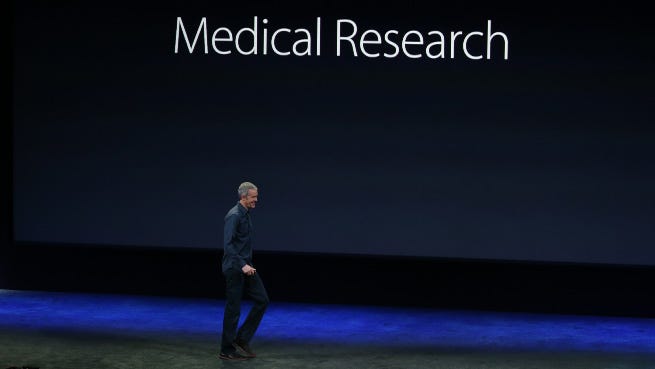
Jeff Williams, senior vice president of operations at Apple, started by laying out the reasons why Apple is investing resources into medical research.
Medical Research is hampered by a number of issues:
- Limited Participation
- Small sample sizes limit our understanding of diseases
- Reliance on subjective data
- Infrequent data provide only snapshots through time
- One-way communication from researcher to participant (and only at the end of the study, if at all)
ResearchKit was developed to combat all of these issues. They’ve launched five apps today in partnership with a variety of collaborators that allow anyone to get involved with medical research.
As the participant you decide how data is shared. Apple will not see your data. You can now be fully involved, seeing your information in real-time, using that data to inform and improve your health.
I’ll end with two quotes from the powerful video that moved me to tears.
“ResearchKit is going to transform medical research.”
“One of the things ResearchKit will do is put people at the center of research.”
We invite you to share your data access stories, and this article with the #qsaccess hashtag and follow along on quantifiedself.com and @quantifiedself.